


Table of Contents
- What Causes an Industrial V-Belt to Slip
- Step-by-Step Diagnosis: Checking the Drive Before You Adjust Anything
- V-Belt Damage Causes: Wear, Contamination and Heat
- V-Belt Failure Chart: Matching Symptoms to Causes
- Preventive Maintenance and Next Steps for Your Drive
- Frequently Asked Questions
Last Updated: November 17, 2026
Industrial V-belts rarely slip for no reason. When a drive starts to squeal, lose power, or run hot, the belt is usually telling you that something in the system has changed. If you are asking why industrial V belts keep slipping, the answer is usually found in a short list of causes that can be checked in order.
According to the U.S. Department of Energy, slippage can reduce drive efficiency by as much as 5% over time when a V-belt is not periodically retensioned (U.S. Department of Energy guidance on replacing V-belts with notched or synchronous belt drives). That loss is easy to miss on a single machine, but it adds up across a plant.
What Causes an Industrial V-Belt to Slip
A V-belt slips when the friction between the belt and the pulley groove is no longer enough to carry the load. The main causes are:
- Low tension: The belt sits too loose and cannot grip the pulley.
- Over-tension: The belt is pulled too hard, which wears the bearings and shortens belt life.
- Worn belt: The cords are stretched, the surface is glazed, or the belt has hardened.
- Worn pulley: The grooves are polished or uneven, so the belt sits too low.
- Misalignment: The pulleys are not in the same plane, so the belt rides on one edge.
- Contamination: Oil, grease, or dust reduces friction.
A slipping drive is not always caused by a loose belt. Timing Belt India notes that engineers should check measured tension, sheave geometry, and load conditions before assuming looseness is the problem (V-belt drive problems that cause slipping and unplanned downtime).
Step-by-Step Diagnosis: Checking the Drive Before You Adjust Anything
Do not tighten the belt first. Adjusting tension on a drive with a worn pulley or a misaligned sheave only hides the real fault. Follow this sequence instead:
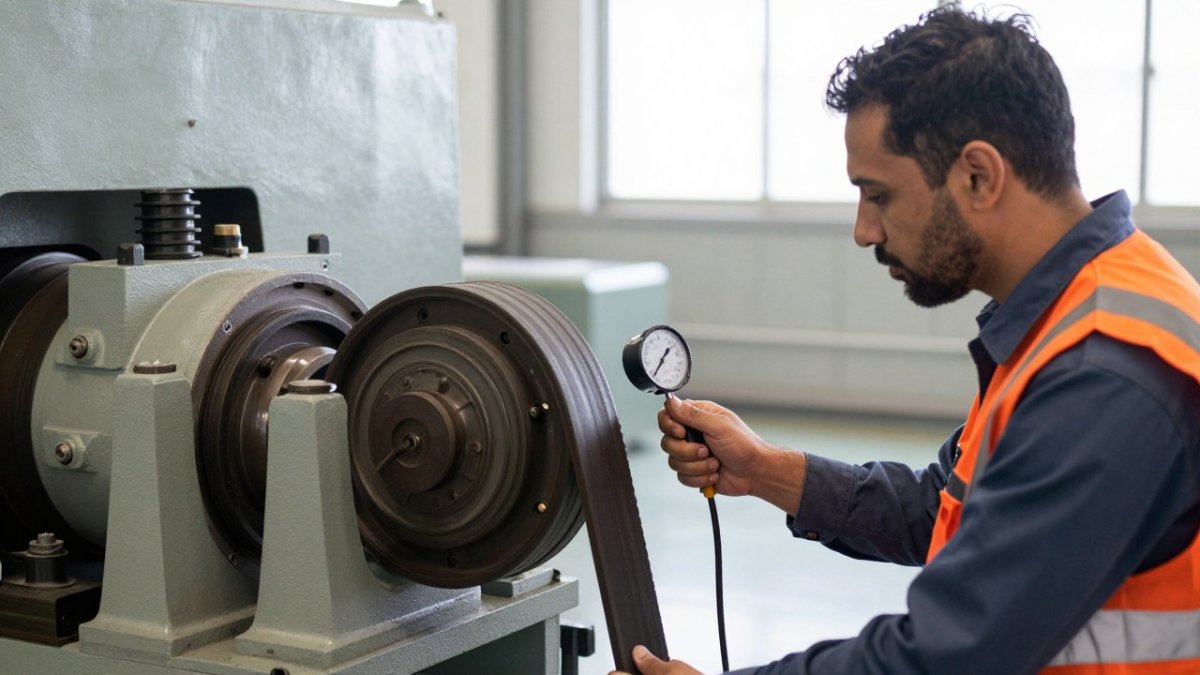
- Lock out and isolate the machine before touching the drive (Maintenance of work equipment).
- Inspect the belt for glazing, cracks, cord exposure, and uneven wear.
- Check the pulley grooves for polishing, a shoulder wear line, or a bottomed belt.
- Confirm alignment with a straight edge or laser tool.
- Measure tension against the manufacturer’s specification.
- Check for oil, grease, or dust on the belt and pulleys.
- Restart and watch for squealing or vibration during startup.
Safety matters at every step. Keep hands clear of moving parts and use the correct guards when the machine is running for test checks.
Checking V-Belt Tension Adjustment
Tension is the most common setting problem. A belt that is too loose slips under load. A belt that is too tight overloads the shaft bearings. Measure the deflection at the midpoint of the span and compare it with the belt supplier’s table. If the belt is worn or stretched, adjusting tension alone will not restore grip. The belt usually needs replacing.
Use matched sets when replacing belts on multi-belt drives. Mixing old and new belts causes uneven load sharing, and the new belt does most of the work and fails early.
Confirming V-Belt Pulley Alignment
Alignment errors are easy to overlook. Lay a straight edge across the faces of both pulleys and check that it touches all four points. For the full steps, tools and tolerances, see pulley alignment steps, tools and tolerances. Then check for angular misalignment by measuring the gap at each side. Even a small offset makes the belt wear on one edge and slip under load.
Once alignment is correct, retension the belt and recheck after a few hours of operation.
V-Belt Damage Causes: Wear, Contamination and Heat
Damage usually shows up as slipping before it shows up as breakage, and each damage type points to a different root cause. Read the belt, not just the symptom.
- Glazing: A shiny, hard surface on the belt flanks. Glazing comes from sustained slip, which generates friction heat and hardens the rubber compound. Once glazed, the belt cannot recover grip by tensioning alone, replace it and find why it slipped.
- Cracking: Small cracks across the underside or ribs that grow with age and heat. Cracking indicates the belt has reached the end of its service life or has been running hot.
- Cord exposure: The outer fabric or rubber is worn through to the tensile cords. This is a structural failure, stop the drive and replace the belt before it breaks.
- Heat damage: Burned or charred rubber, often on the pulley contact faces. Heat and slipping feed each other: friction from a slipping belt raises temperature, which hardens the rubber, which makes the belt slip more. A drive running hot is a drive that is already slipping.
- Oil or grease contamination: Swollen, soft rubber that loses shape and grip. Oil attacks the rubber compound, so cleaning the belt is not a fix, find and stop the leak, then replace the belt.
- Uneven wear: One edge worn more than the other points to misalignment or a worn pulley groove, not to the belt itself.
Pulley groove wear is the damage cause most often missed. A worn groove lets the belt sit too low, so it contacts the groove bottom instead of gripping the flanks. Check for a polished shoulder line inside the groove and for a belt that sits flush with or below the pulley rim. Compare groove width against the pulley specification; when the groove has widened beyond the manufacturer’s limit, the pulley needs replacing, not the belt.
Stop the drive, find the cause, and replace damaged belts rather than running them to failure. A belt that has failed once from a correctable cause will fail again until that cause is fixed.
V-Belt Failure Chart: Matching Symptoms to Causes
Use this table to narrow down the cause quickly:
| Symptom | Likely Cause | First Check |
|---|---|---|
| Squealing at startup | Low tension or glazed belt | Measure tension, inspect belt surface |
| Belt rides high in groove | Worn pulley | Check groove wear |
| Uneven wear on one edge | Misalignment | Straight edge check |
| Cracked or hardened belt | Heat or age | Inspect belt and drive temperature |
| Oily or swollen belt | Contamination | Clean drive, find oil source |
| Belt jumps or vibrates | Over-tension or mismatched belts | Measure tension, check belt set |
Preventive Maintenance and Next Steps for Your Drive
Regular checks prevent most slipping problems. Build these into your schedule:
- Check tension at each planned inspection and retension after the first few hours of new belt operation.
- Inspect pulleys for groove wear and replace them when grooves are visibly worn.
- Keep oil, grease, and dust away from the drive with guards and regular cleaning.
- Replace belts in matched sets.
- Keep a record of belt type, size, and replacement dates for each drive.
When you need a replacement, send a photo or a sample of the used belt so we can match the correct width and type for your machine. To work through the choice yourself, read how to choose the right V-belt for your machinery. We stock all types of V-belts, including authorised Bando belts, and we offer 30-minute bike delivery across multiple emirates in the UAE. Confirm the part before you order. Learn how to identify genuine Bando industrial belts before you buy. For professional assistance with a slipping drive, contact our team and we will help you find the right belt for your equipment.
Frequently Asked Questions
What are the possible causes of a V-belt slipping problem?
The most common causes are incorrect belt tension (both under- and over-tension), worn or glazed belts, worn or mismatched pulleys, misalignment between sheaves, and contamination from oil, grease or dust. Slippage can also follow a change in load, such as a machine running heavier than its drive was designed for. Work through these causes in order, starting with tension and alignment, since they are the quickest to check and the most frequent culprits. If the belt shows hardening or cracking after the basic checks, replacement is usually the right step. If you send a photo or sample of a used belt, the belt can be matched to a suitable replacement.
Can incorrect belt tension make an industrial V-belt slip?
Yes. A belt that is under-tensioned cannot grip the pulley grooves firmly enough to transmit the load, so it slips under torque. An over-tensioned belt can also cause problems, because excessive force loads the bearings and shortens belt life. Slippage is not always caused by a loose belt, though, so measure tension against the manufacturer’s specification before adjusting. Retension periodically, since a belt that is not checked can lose efficiency over time.
How do worn or misaligned pulleys cause V-belt slippage?
Worn pulley grooves reduce the contact area between the belt and sheave, so the belt rides lower in the groove and loses grip. Misalignment places the belt at an angle to the sheave, which wears one side of the belt and creates uneven contact. Both conditions can make a correctly tensioned belt slip. Check groove wear with a gauge or profile template, and check alignment with a straight edge across the sheave faces. Replace sheaves that show significant groove wear rather than trying to run a new belt on them.
When should a slipping V-belt be replaced?
Replace the belt when it shows cracking, glazing, hardening, fraying, or uneven wear across its width, or when it still slips after tension and alignment have been corrected. Belts that have stretched beyond their adjustment range also need replacing. Always replace belts as a matched set on multi-belt drives so the load is shared evenly. Use a belt of the correct type and size for the machine, and source it from a supplier that stocks genuine Bando or Aquil Star products for reliable performance.

Leave a Reply