

Last Updated: November 8, 2026
Quick Summary
Emergency belt supply for plants means sourcing a replacement V-belt or conveyor belt fast enough to restart production before the stoppage becomes a contractual problem. The fastest recovery follows a fixed sequence: stop safely, identify the belt, source it, install it, and restart under observation. Brief your supplier with specification data, not a description, so they can confirm stock and dispatch without a call-back.
- Record V-belt section letter, length, belt count and pulley groove profile before calling a supplier.
- An adjustable link V-belt is a temporary fix only, with lower efficiency and more vibration.
- Spin every idler by hand during inspections, since a seized idler wears through belt covers fast.
- Keep a belt register so failure identification becomes a two-minute phone call.
- AQUIL STAR General Trading LLC operates a Just in Time delivery policy with vast stocking systems.
Table of Contents
- Emergency Belt Supply for Plants: What to Do When a Belt Fails
- Emergency V-Belt and Conveyor Belt Sourcing: A Step-by-Step Response Workflow
- Adjustable Link V-Belt vs Standard Belt: Temporary Fix or Permanent Replacement
- Conveyor Belt Maintenance in Plants: Reducing the Next Failure
- Why Local Industrial Belt Suppliers Cut Downtime in the UAE
- Building an Emergency Belt Procurement Checklist for Your Plant
- Frequently Asked Questions
Emergency Belt Supply for Plants: What to Do When a Belt Fails
A conveyor belt failure does not announce itself. At AQUIL STAR General Trading LLC, we supply V-belts and conveyor belting across the UAE, and plants that recover fastest tend to be the ones that prepared before the belt broke.
The first hour matters more than the next ten. A seized idler or a torn belt cover is rarely the real emergency.
Emergency V-Belt and Conveyor Belt Sourcing: A Step-by-Step Response Workflow
The fastest recovery follows a fixed sequence: stop safely, identify the belt, source it, install it, and restart under observation.
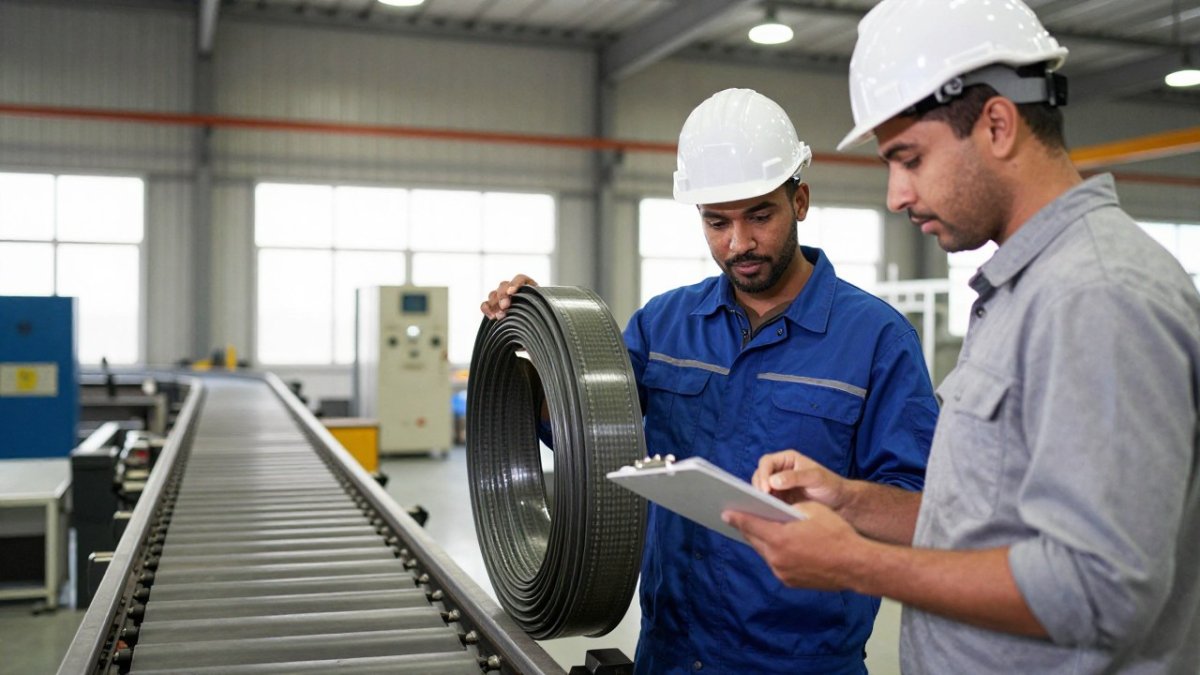
Here is the workflow we recommend to every plant team:
- Trigger the emergency stop and lock out. Pull the cord, isolate the drive, and apply lockout-tagout before anyone touches the belt. Confirm the belt is at zero energy: drives de-energised, gravity loads blocked, and stored tension released before covers come off.
- Make the area safe and contain the damage. Barricade the line, clear spilled material, and check for hot surfaces or frayed carcass. Photograph the belt, the splice, the idler, and any groove damage on the pulley. Note the belt markings: profile, length, and brand.
- Capture the specification data. For a V-belt, record the section letter (A, B, C, D, or the SP/XP metric equivalents), the inside or datum length, the number of belts in the drive, and the pulley groove profile. For a conveyor belt, record width, overall length, ply or carcass construction (for example EP or steel cord), cover grade, and splice type and length. If markings are worn, measure the pulley pitch diameter and groove angle rather than guessing.
- Confirm against the plant register or manual. Match the captured data against the machine manual or belt register. A V-belt section letter or a conveyor belt width and ply count must be exact. If the register is missing, start one now.
- Brief the supplier with data, not a description. Send one message containing: profile or belt type, length, width and ply (for conveyor), quantity, operating conditions (load, temperature, exposure to oil or abrasives), required delivery time, and site address with access details. A supplier who receives this can confirm stock and dispatch without a call-back.
- Confirm availability and dispatch before you commit. Ask for the stock location, dispatch time, and expected arrival window in writing. If the exact belt is not in stock, ask what the nearest compatible option is and what the trade-off is, rather than accepting a substitute silently.
- Install and tension correctly. Fit the belt, check alignment, and re-tension after the first run-in period. For V-belts, match the set and re-check tension after the first few hours of running.
- Run under observation. Watch for tracking issues, unusual noise, and heat build-up for the first shift, and log the replacement in the belt register.
Watch out: ordering a “close enough” belt to save an hour can lead to repeat failures.
Adjustable Link V-Belt vs Standard Belt: Temporary Fix or Permanent Replacement
An adjustable link V-belt is a temporary solution for getting a line running while the correct belt is in transit. It is not a permanent replacement.
| Option | Best For | Trade-off |
|---|---|---|
| Adjustable link V-belt | Bridging a stoppage while the correct belt ships | Lower power transmission efficiency, more vibration |
| Standard wrapped V-belt | Permanent drive service | Requires the exact profile and length |
| On-site splicing | Large conveyor belts that cannot be removed whole | Needs skilled technicians and correct splice length |
But a link belt running for weeks wears pulleys unevenly and can damage groove profiles. Use it to buy hours, not months.
For conveyor belts, the equivalent decision is temporary rip repair versus full replacement.
Conveyor Belt Maintenance in Plants: Reducing the Next Failure
Conveyor belt maintenance in plants is mostly about the parts around the belt, not the belt itself.
A preventive maintenance routine that actually reduces failures covers four checks:
- Idlers: spin every idler by hand during inspections. A seized idler will wear through a belt cover fast.
- Tracking and alignment: check belt tracking weekly. Persistent drift usually points to a pulley or structure issue.
- Tension: verify tension against the manufacturer’s spec. Loose belts slip; over-tight belts overload bearings.
- Splice condition: inspect splice length and integrity on every planned shutdown.
Beyond the routine, build a plant-wide emergency inventory and supplier-readiness plan. This is what separates a plant that restarts in hours from one that waits on a vessel.
- Identify critical spares. List every conveyor and V-belt drive, then rank each by the production impact of a failure. A belt on a single-line conveyor feeding a kiln or a packing line is critical; a belt on a redundant transfer is not. Hold stock against the critical list first.
- Set minimum stock levels and reorder points. For each critical belt, agree a minimum quantity on the shelf and a reorder point that accounts for the supplier’s realistic lead time, not the catalogue lead time. Review the levels after every failure and every change in duty.
- Keep a belt register. Record profile, length, width, ply, cover grade, brand, and quantity held for every system. When a belt fails, that register turns a two-hour identification exercise into a two-minute phone call.
- Agree supplier readiness in advance. Ask each supplier what they hold in stock locally, what their after-hours response is, and how they confirm availability. Put the escalation path and after-hours numbers in the register so any shift engineer can use them.
- Plan for lead-time and shipping disruption. For belts that must be imported, keep at least one spare on site or agree a consignment or buffer-stock arrangement with the supplier. A port delay should not stop a critical line.
The Intralox case study on emergency belt replacement shows how next-day delivery supported a beverage plant’s emergency replacement, which is exactly the kind of supplier readiness worth building toward.
Why Local Industrial Belt Suppliers Cut Downtime in the UAE
Local industrial belt suppliers can reduce downtime because they hold stock in-country, avoiding the customs and freight delays of overseas orders. An overseas order carries customs clearance, freight scheduling, and a vessel window that no plant can control.
The case for a local stockist rests on three practical points:
- Stock on hand. A supplier with a vast stocking system can confirm availability immediately instead of quoting a lead time.
- After-hours availability. Breakdowns do not wait for office hours.
- Genuine branded product. Buy from a supplier who stocks recognised brands such as Bando and Aquil Star V-Belts.
AQUIL STAR General Trading LLC operates a Just in Time delivery policy. Our vast stocking systems and experience in rubber technology and engineering since 1994 support fast fulfilment of industrial requirements.
Building an Emergency Belt Procurement Checklist for Your Plant
An emergency belt procurement checklist is a one-page document that tells any shift engineer exactly what to do and who to call when a belt fails.
Use this checklist as your template:
- Belt register completed for every conveyor system and V-belt drive
- Minimum stock levels agreed for critical belts, with reorder points
- Supplier contact list with after-hours numbers and escalation path
- Emergency order process documented, including who can approve spend
- Specification data stored for every critical belt: profile, length, quantity
- Temporary repair kit on site: link belt, repair kit, on-site bonding materials
Review the checklist every quarter and after every failure. A plant that maintains it well will still have breakdowns. It just will not lose days to them.
A belt failure is inevitable; a week of lost production is not.
Frequently Asked Questions
How can a plant get a replacement belt quickly during an equipment breakdown?
Call your supplier as soon as the failure is confirmed and have the belt specification ready: type, profile, length, and any brand or part number. A local stockist with a Just in Time delivery policy can dispatch from existing stock rather than wait on an import. AQUIL STAR has supplied V-belts and conveyor belting in the UAE since 1994 and holds stock from brands including Bando and Aquil Star V-Belts,
What information should I provide when ordering an emergency industrial belt?
Give the supplier the belt type (V-belt, link belt, or conveyor belt), the profile or cross-section, the inside length or pitch length, the machine make and model, and the number of belts in the drive. A photo of the failed belt and the pulley or conveyor head helps confirm the match. If the original part number is worn off, measure the belt and note any groove damage or seized idler that may have caused the failure, so the replacement is not damaged the same way.
Can an emergency V-belt be used as a permanent replacement?
An emergency V-belt is a short-term fix to get production running again, not a long-term answer. Once the line is back up, order the correct OEM-specification belt and schedule a planned changeover. Running on an emergency belt for weeks risks repeat failure, uneven pulley wear, and unplanned downtime at a worse moment. Treat the emergency belt as a bridge, and log the changeover date so it does not become permanent by default.
Why choose a local industrial belt supplier for emergency orders?
A local supplier holds stock in the UAE, which can shorten delivery compared with overseas orders. That matters when a belt failure stops a production line. AQUIL STAR stocks Bando and Aquil Star V-Belts products and runs a Just in Time delivery policy.

Leave a Reply