


Last Updated: November 2, 2026
Quick Summary
Local industrial belt suppliers keep critical belts in stock, so a failed drive belt can be replaced in hours instead of weeks. Overseas orders add shipping and customs time, and during an unplanned stoppage downtime costs far more than the part itself.
- Overseas orders can take weeks once shipping and customs are included.
- The industrial V-belt market is forecast to grow from USD 144.7 million in 2026 to USD 266.5 million by 2036.
- Ask suppliers which of your specific belt part numbers they hold in local stock right now.
- Request authorised-brand documentation and batch traceability to avoid counterfeit belts.
- Test any after-hours number before you need it in an emergency.
Table of Contents
- Why Local Stock Matters When a Line Goes Down
- How to Choose an Industrial Belt Supplier
- Emergency Industrial Belt Supply: What a 2 AM Breakdown Really Requires
- Industrial Belt Stock Availability for Older and Non-Standard Equipment
- Just-in-Time Industrial Delivery Across Multiple UAE Sites
- Verifying Genuine Bando and Aquil Star V-Belts Products
- Total Cost of Ownership: What You Pay For and Where It Returns
- Your Next Step: Auditing Your Current Belt Supply Chain
- Frequently Asked Questions
Local Industrial Belt Suppliers: Faster Supply, Lower Downtime
AQUIL STAR General Trading LLC supplies V-belts and conveyor belting across the UAE, and the question maintenance teams often ask is simple: why buy locally when parts are available from abroad? The answer usually comes down to time. When a drive belt fails, the cost is measured in idle machines, not in the price of the belt itself.
Why Local Stock Matters When a Line Goes Down
When a line stops, every hour of downtime costs more than the part. A local stockist with the right belts on hand can often respond much faster than an overseas order, which can take weeks once shipping and customs are included.
The market data points in the same direction. The industrial V-belt market is forecast to grow from USD 144.7 million in 2026 to USD 266.5 million by 2036, a 6.3% CAGR, according to Future Market Insights industrial V belts market forecast. Growth on that scale means more machines relying on belt drives, and more demand for dependable local supply to keep them running.
How to Choose an Industrial Belt Supplier
Choosing a local industrial belt supplier is not a price comparison exercise. It is a risk assessment. The right supplier shortens downtime, reduces administrative load, and gives you a single point of accountability when a critical belt fails. The wrong one adds lead time, uncertainty, and hidden costs.
Start with stock depth, not price alone. Ask how many of your belt part numbers are physically held in the UAE and how quickly the supplier can reach each of your sites. A supplier who stocks your critical references locally can usually deliver faster than one who orders from overseas, where shipping and customs add time.
Check the brands they carry and whether they can verify authenticity. Counterfeit belts are a real concern, so request documentation that traces each belt to its manufacturer and confirm the supplier’s distributor status. Also confirm that they handle non-standard and legacy sizes, since older equipment often needs belts that no longer appear in standard catalogues.
A practical supplier-vetting checklist should cover these questions:
- Which of my specific belt part numbers do you hold in local stock right now?
- What is your standard lead time to each of my sites, and what is your emergency response time?
- Can you provide authorised-brand documentation and batch traceability for every belt?
- Do you support legacy, discontinued, and non-standard sizes, and how do you source them?
- Who is my named contact for technical questions and emergency orders?
- What warranty or performance guarantee do you offer on belts and on delivery commitments?
- Can you share references from similar operations in my industry?
Beyond the checklist, ask for measurable performance commitments. Response time, fill rate (the percentage of order lines shipped complete on first request), on-time delivery percentage, and time to resolve technical issues are useful metrics for separating a reliable local supplier from a merely nearby one. Ask the supplier to state these figures and to put delivery and emergency-service terms in writing.
Watch out: a supplier who quotes the lowest price but cannot confirm local stock for your critical part numbers may cost more in downtime than the price difference saves.
Finally, ask about delivery to multiple sites if your operation spans several locations. Inconsistent delivery times across sites often point to fragmented supply chains, and that inconsistency shows up as unplanned downtime.
Emergency Industrial Belt Supply: What a 2 AM Breakdown Really Requires
A 2 AM breakdown tests a supplier’s real capacity. Three things matter most: whether the belt is physically in the warehouse, whether someone will answer the phone, and whether delivery can happen before the night shift ends.
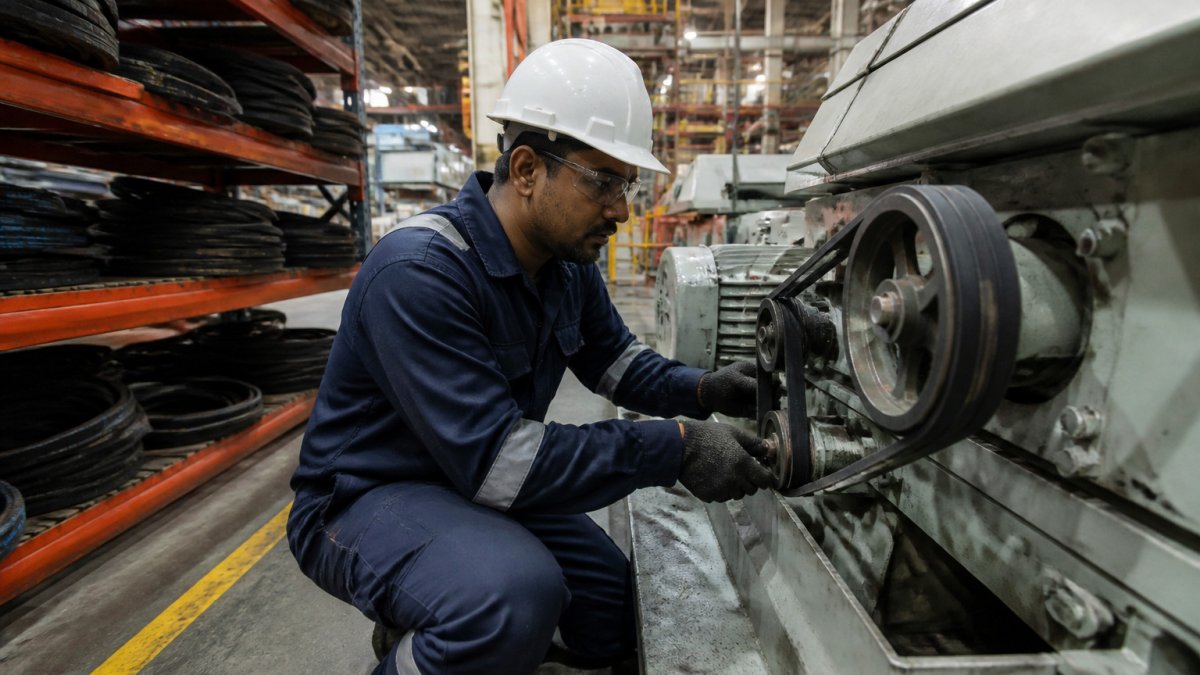
Maintenance engineers at manufacturing plants are often the ones making this call under pressure. A supplier that can confirm stock availability within minutes lets the team decide whether to repair, swap, or wait. That decision hinges on information the supplier must be able to give immediately: the exact part number in stock, the quantity available, the location of the nearest warehouse, and a realistic delivery time to the site.
Emergency supply is not only about the supplier’s warehouse. It is also about your own contingency planning. Holding a small critical-spares stock of the belts that would stop the line if they failed, and recording every belt size on critical equipment, can make emergency ordering faster and more accurate. Pairing that with a documented after-hours contact and an agreed escalation path helps turn an overnight call into a routine transaction.
When evaluating a supplier’s emergency service, ask for specifics rather than assurances:
- Is there a dedicated after-hours phone number, and who answers it?
- What is the committed response time for stock confirmation and for delivery to my site?
- Can the supplier deliver outside normal business hours, and at what notice?
- Are emergency orders priced differently, and what are the terms?
- Will the supplier hold contingency stock for my critical references on request?
Pricing depends on quantity, delivery timing, and the specific belt. For current rates and emergency service terms, contact AQUIL STAR General Trading LLC directly.
Watch out: a supplier who advertises 24/7 service but cannot name the person who answers the phone at night is unlikely to deliver before the night shift ends. Test the number before you need it.
Industrial Belt Stock Availability for Older and Non-Standard Equipment
Older conveyor systems frequently use belt sizes that no longer appear in standard catalogues. Waiting for a custom order can extend downtime.
The practical test is to bring a list of your current belt references, including any that are discontinued or non-standard, and ask the supplier which ones they can source or stock.
Keep a record of every belt size on your critical equipment. It makes emergency ordering faster and reduces the chance of ordering the wrong part.
Just-in-Time Industrial Delivery Across Multiple UAE Sites
Just-in-time delivery can reduce the stock you need to hold on site. It depends on the supplier being able to deliver consistently to each location.
If your operation spans several UAE sites, ask for delivery schedules and lead times for each one. Inconsistent delivery times across sites often point to fragmented supply chains, and that inconsistency shows up as unplanned downtime.
Verifying Genuine Bando and Aquil Star V-Belts Products
Counterfeit belts are a real concern in the market. Buyers should request documentation that traces each belt to its manufacturer and check packaging, markings, and batch details on arrival.
AQUIL STAR General Trading LLC carries products from Bando and Aquil Star V-Belts. Ask for product documentation with any order so you can confirm what you are installing.
Total Cost of Ownership: What You Pay For and Where It Returns
The purchase price of a belt is only part of its cost. Downtime, labour during replacement, and the damage a failed belt can cause to pulleys and bearings often cost far more.
According to Thomasnet industrial conveyor belt market overview, heavy-duty belts account for a large share of conveyor belt revenue, which reflects how much industry depends on durable belting. Buying a belt that lasts longer and is available quickly tends to reduce the total cost of keeping equipment running.
When comparing quotes, ask each supplier how the belt’s expected service life, stock availability, and delivery speed affect your overall cost of ownership.
The table below sets out the cost factors the article identifies, so the main drivers of total cost are easy to scan.
| Cost factor | What it covers | Note |
|---|---|---|
| Purchase price | The price of the belt itself | Only part of the total cost |
| Downtime | Idle machines while a belt is replaced | Often costs more than the part |
| Replacement labour | Staff time to fit the new belt | Adds to cost on every failure |
| Pulley and bearing damage | Harm a failed belt can cause | Can exceed the belt’s price |
| Service life | How long a durable belt lasts | Longer life reduces replacements |
| Stock availability and delivery speed | Time to get a belt on site | Affects downtime duration |
Your Next Step: Auditing Your Current Belt Supply Chain
Start by listing every belt on your critical equipment, noting how long each replacement has taken in the past and what each delay cost your operation. That list shows where local stock would make the biggest difference.
Then request stock confirmation and delivery commitments from your current supplier and at least one local option. Compare the answers side by side.
If you want to test your current setup against local stock, get in touch with AQUIL STAR General Trading LLC for a stock check on your belt references.
Frequently Asked Questions
Why should a UAE plant buy industrial belts from a local supplier instead of an international one?
A local supplier that holds stock in the UAE can usually ship faster than waiting for overseas freight, which can take weeks. For plants where a stopped conveyor costs money every hour, the faster replacement usually matters more than a small difference in unit price. Pricing depends on quantity, dates and delivery terms, so request a current quote from AQUIL STAR General Trading LLC on the website.
How do I know an industrial belt supplier will have stock when I need it?
Ask the supplier how many part numbers they hold in the UAE, whether they stock common V-belt profiles and conveyor belting, and what their lead time is for items not on the shelf. Ask whether a supplier with a stocking system can cover your standard sizes and how it handles non-standard sizes, including lead times. Keep a list of your belt part numbers and check availability before you need them, not during a breakdown.
What information should I give when requesting a replacement belt?
Provide the belt section or profile, the exact length (in millimetres), the number of ribs for multi-rib belts, and the make and model of the machine. If the original belt is available, send a photo of its marking or bring it in. For conveyor belts, give the width, thickness, cover type and operating temperature. Accurate specifications prevent the wrong belt from being shipped, which is one of the most common causes of extra downtime.
Can a local supplier help with old equipment that uses non-standard belt sizes?
Ask whether the supplier can help match a belt by measurement or cross-reference. Send the existing belt’s dimensions and a photo of the drive layout. For non-standard sizes, ask whether the supplier can cut conveyor belting to length or source an equivalent profile, and confirm the lead time in writing before relying on it for a planned shutdown.

Leave a Reply