


Quick Summary
To identify genuine bando belts, check the part number against the official catalog, inspect the printed markings and packaging, and measure the belt’s width and length before installation. Visual checks can screen out obvious fakes, but measurements and supplier documentation are what confirm a belt is genuine.
- Confirm the part number on the box matches your equipment specification and appears in the official catalog.
- Check that printed markings are sharp, evenly spaced and free of blurring or uneven spacing.
- Measure top width and inside length, then compare them to the catalog specification.
- Counterfeiters often invest in packaging and printing but neglect dimensional accuracy, so measure every belt.
- If a belt fails any check, do not install it; keep the packaging and contact your supplier.
Table of Contents
- Why Verifying a Bando Belt Matters Before Installation
- Step-by-Step Inspection: Labels, Markings and Packaging
- Bando Belt Part Number Lookup and Catalog Cross-Checks
- Bando Belt Original vs Fake: Measurements and the Limits of Visual Checks
- Industrial Belt Inspection Checklist and Next Steps with Your Supplier
- Frequently Asked Questions
Why Verifying a Bando Belt Matters Before Installation
Last Updated: November 7, 2026
Counterfeit and mislabeled belts are a real concern in industrial supply. At AQUIL STAR General Trading LLC, we supply V-belts and conveyor belting, and checking a belt before it goes on a machine saves time and money.
Market research points to steady growth in industrial V-belts. Market Research Future’s Industrial V-Belt Market report forecasts the market moving from USD 1.77 billion in 2026 to USD 2.84 billion by 2035.
Bando is one of the most widely used brands for industrial belting. Owners and mechanics sometimes debate whether aftermarket belts match original ones.
A wrong belt can slip, wear fast, or fail under load. That means unplanned downtime, damaged pulleys, and extra labor. Verifying the belt first costs far less than fixing the damage afterward.
Step-by-Step Inspection: Labels, Markings and Packaging
Start with the packaging and printed text. This is the fastest first check, and it costs nothing.
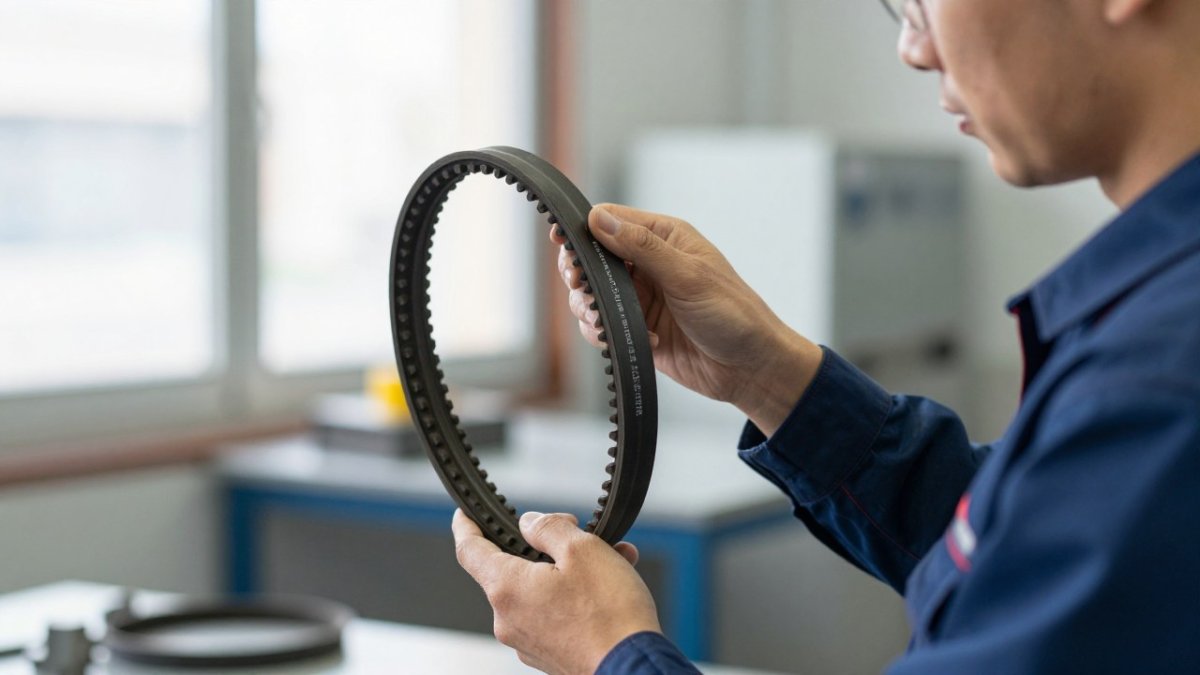
First, look at the box and the belt together.
For V-belts and variable-speed belts:
- Confirm the brand name and part number are present and legible.
- Check that the size designation (e.g., A, B, C, 3L, 5L, or metric SPZ, SPA, SPB, SPC) is printed clearly and matches the catalog.
- Look at the top width and the included angle. A genuine V-belt has a clean, uniform profile; counterfeit belts often have rounded or inconsistent edges.
- Inspect the tensile cord area if visible at the ends. Genuine belts show uniform cord placement; loose or uneven cords are a warning sign.
- Check the bottom of the belt for a clean, flat surface. Some counterfeit V-belts have a rough or fabric-covered bottom that does not match the specified design.
For timing belts:
- Confirm the tooth profile (e.g., trapezoidal, curvilinear, or modified curvilinear) matches the catalog description.
- Count the teeth and verify the pitch (the distance between tooth centers) against the part number. A belt with the wrong pitch will not seat correctly in the pulley grooves.
- Inspect the tooth surface for uniform shape and clean edges. Counterfeit timing belts often have uneven tooth heights or flash (excess material) at the tooth roots.
- Look for the backing material and any fabric facing. Genuine belts have a consistent backing; delamination or loose fabric is a red flag.
For all belt types, check the printed text quality. Genuine products usually show sharp, evenly spaced characters with uniform depth.
Watch out: Visual checks can catch obvious fakes, but they cannot prove a belt is genuine.
Reading the printed text and font quality
Print quality is one of the clearest signs to watch, but it is also one of the easiest to overinterpret. Genuine products usually show sharp, evenly spaced text with uniform depth. Counterfeits often have blurred edges, uneven spacing, or fonts that look slightly off.
Compare the belt against a known genuine sample if you have one. Put them side by side under good light. Look at how the logo, the numbers, and the length markings are formed.
Checking belt material, surface finish and construction
Touch and look at the belt body. Genuine belts generally have a consistent surface finish with no obvious patches, bubbles, or rough spots. The rubber should feel uniform, not tacky or unusually hard in places.
Be aware of limits. Material feel varies a little between production runs, and some genuine belts may have minor cosmetic flaws. No single feature proves authenticity on its own.
The article suggests checking the following features by belt type before installation.
| Belt type | Check | What to look for |
|---|---|---|
| V-belts and variable-speed belts | Size designation | Clear and matches the catalog |
| V-belts and variable-speed belts | Profile edges | Clean, uniform; rounded or inconsistent edges are a warning |
| V-belts and variable-speed belts | Bottom surface | Clean, flat; rough or fabric-covered bottom is a warning |
| Timing belts | Tooth profile | Matches the catalog description |
| Timing belts | Pitch | Matches the part number; wrong pitch will not seat correctly |
| Timing belts | Tooth surface | Uniform shape; flash at tooth roots is a warning |
| All belts | Printed text | Sharp, evenly spaced; blurred or uneven text is a warning |
| All belts | Packaging | Logo, part number, size and country of origin present |
Bando Belt Part Number Lookup and Catalog Cross-Checks
The part number is your strongest reference point. Look it up in the official catalog before you buy or install.
Manufacturers of industrial belting generally publish catalogs listing part numbers, profiles, and dimensions.
Cross-referencing also helps when your old belt is worn or unreadable.
A quick cross-check routine:
- Read the part number from the box or belt
- Find that number in the official catalog
- Confirm the profile, length, and width match
- Compare against your equipment’s required specification
If the part number does not appear in the official catalog, do not install the belt until you verify it with the supplier.
Bando Belt Original vs Fake: Measurements and the Limits of Visual Checks
Measurements give you facts that looks cannot. Use a tape measure or caliper to check the belt before installation.
For V-belts and variable-speed belts:
- Measure the top width at several points along the belt. Compare the average to the catalog specification. A belt that is even slightly narrow or wide will ride wrong in the pulley groove.
- Measure the inside length (also called the pitch length for some profiles) by wrapping a tape around the inside of the belt or using a belt length gauge. Compare to the catalog.
- Check the included angle of the V-profile if you have a gauge. Genuine belts hold a consistent angle; counterfeit belts may be off by a few degrees, which affects grip and wear.
For timing belts:
- Measure the pitch (distance between tooth centers) using a caliper across several teeth, then divide by the number of intervals. Compare to the catalog pitch.
- Measure the width of the belt and the tooth height. Both should match the specification.
- Count the teeth and confirm the number matches the part number. A belt with the correct pitch but wrong tooth count is still the wrong belt.
For all belts, record your measurements and compare them to the official Bando catalog.
Visual checks have clear limits. A counterfeit can look convincing, and a genuine belt can have minor cosmetic flaws.
When you find a suspicious belt:
- Stop and do not install it.
- Keep the packaging, receipt, and any documentation that came with the belt.
- Contact the seller and ask for proof of sourcing and product documentation.
- Report the issue to the manufacturer if you suspect counterfeiting. Manufacturers have an interest in tracking counterfeit products and can usually advise on next steps.
- Document the part number, measurements, and where you bought it. This information helps your supplier and the manufacturer address the problem.
A failed belt in service can damage pulleys, shafts, and bearings. Taking time to verify saves much larger repair costs later.
Industrial Belt Inspection Checklist and Next Steps with Your Supplier
Use this checklist before every installation:
- Part number matches the equipment specification
- Part number confirmed in the official catalog
- Printed markings are sharp, even, and error-free
- Surface finish and construction look consistent
- Length and width measured and matched to the catalog
- Packaging and documentation are present
If any item fails, pause the installation and speak with your supplier. Ask for proof of sourcing and product documentation.
Buying from a dependable supplier reduces the risk of counterfeit parts. At AQUIL STAR General Trading LLC, we stock Bando and Aquil Star V-Belts products and support our customers with a Just in Time delivery policy. Pricing depends on quantity, dates, and delivery, so contact us for a current quote.
Frequently Asked Questions
How can I tell if a Bando belt is original or fake?
No single visual check settles it. Start by comparing the printed markings, font clarity and packaging against the manufacturer’s current reference material, then confirm the part number and measured dimensions. Forum users report differences in surface appearance between aftermarket and dealer-supplied Bando belts, but these are informal observations, not verified guidance. Visual signs such as blurred text or inconsistent finish should prompt a closer check, not a verdict. The most reliable confirmation comes from buying through an authorized supplier who can provide traceable documentation for the part.
What is the part number for a Bando belt?
The part number is printed on the belt or its packaging and corresponds to a specific profile, length and construction. Use the manufacturer’s catalog or a cross-reference tool to match the number to your equipment’s original specification. Always record the part number from the old belt or the equipment manual before ordering, since a mismatched length or profile will fit poorly even if the belt itself is genuine. If the number does not appear in any catalog you can access, treat that as a reason to verify with the supplier.
Can packaging alone confirm that a Bando belt is genuine?
Packaging helps but cannot confirm authenticity on its own, because packaging can be copied. Check that the box carries the same part number as the belt, that print quality is consistent and that the labeling matches current reference material. Keep the packaging with the belt until installation so the part number can be checked later. For high-stakes applications, pair packaging checks with dimensional measurements and documentation from an authorized seller.
What should I do if a Bando belt has no visible markings?
Do not install a belt with no visible markings until you have verified it. Measure its length, width and profile against the old belt or the equipment specification, and ask the supplier for the part number and traceable documentation. If the seller cannot provide these, consider the belt unverified and source it elsewhere. Industrial failures from wrong or substandard belts can cause unplanned downtime, so the cost of a short verification step is usually small by comparison.

Leave a Reply